
Andy Burnham declares that UK will fight 'poisonous tide' of Russian disinformation
Prime Minister Andy Burnham has announced a new UK centre to tackle hostile disinformation campaigns while calling for international standards to make artificial intelligence safer.
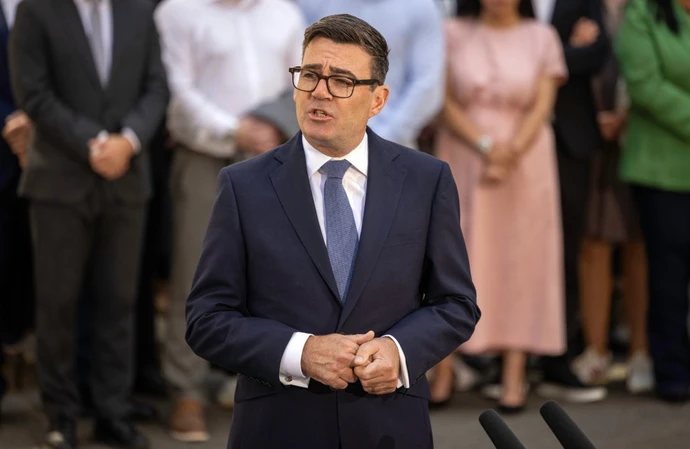
Prime Minister Andy Burnham has announced plans for a new UK centre to tackle hostile disinformation, including campaigns attributed to Russia, as he called for international cooperation on artificial intelligence safety.
Speaking at the United Nations General Assembly in New York, Burnham said Russian agencies had used bots, fake websites and falsified media content to spread what he described as lies and disinformation.
Burnham told world leaders: "The Kremlin spends around £1.3 billion each year on manipulating information.
"They've used bots and fake websites, falsified newspaper articles, forged the branding of 28 British organisations, including universities and the BBC."
Burnham said the campaign was an "insidious" effort that could reach into people's homes, create a narrative of decline, stoke division and sow despair.
He also warned that AI could make the threat more difficult to tackle by allowing hostile actors to create and distribute misleading material at greater speed and scale.
The Labour leader said: "On top of that we have seen cyber-attacks on our companies and institutions. And we know that AI will multiply the threat."
To counter this, Burnham announced a new National Centre for Information Defence, which will aim to detect and disrupt AI-enabled disinformation campaigns by hostile states.
The centre will work alongside intelligence agencies, government departments, law enforcement and social media companies to bring together expertise in tackling what the government describes as "information warfare".
Russia has previously rejected UK allegations of interference and described claims about Russian activity as "Russophobia".
Russian foreign minister Sergei Lavrov also criticised Western media in a speech in Moscow before Burnham's address.
Burnham also used his UN speech to set out plans for the UK to play a larger role in international AI policy.
He described frontier AI as "one of the most significant challenges and opportunities of our age", saying the technology could drive economic growth while also acting as a "multiplier of risk".
Burnham said: "We've all heard the warnings - which we must heed. I know how worried people are. So we have to rise to this moment."
The Prime Minister said the UK was in a "unique position as an honest broker", with close relationships with both the US and European Union (EU).
He pledged to put AI "at the heart of the UK's G20 Presidency next year", when leaders of the world's largest economies will gather in Manchester.
Burnham said the UK would work towards global principles covering transparency, access to AI models and safe development.
However, any international agreement faces significant challenges.
The US and China, which dominate global AI development, have not signed Norway's recent declaration calling for frontier AI to remain under human control and undergo mandatory pre-release testing.
US President Donald Trump rejected calls for greater international controls on AI in his own UN address, saying: "We're going to encourage it, not rein it in."