
Robot cops put on traffic duty in China
China is testing wheeled police robots that use cameras, radar and AI to monitor traffic violations, marking a push to move humanoid machines into practical public-service roles.
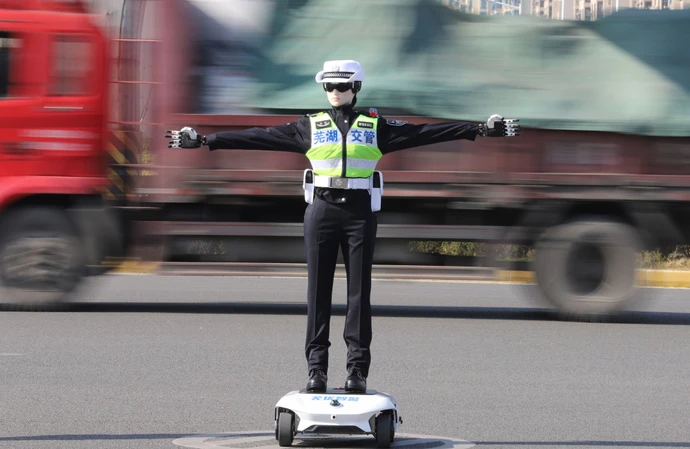
China is putting robots on traffic duty as it looks to automate some of the repetitive work normally carried out by police officers.
At a busy intersection in Hangzhou, eastern China, a 1.88-metre robot can identify traffic violations, issue warnings and move its mechanical arms in time with traffic lights.
The T2 robot, developed by local technology firm SUPCON Information, weighs 98kg and uses cameras, radar and onboard computing to detect helmetless e-bike riders, passengers on e-bikes, vehicles crossing stop lines and pedestrians ignoring traffic signals.
It can also answer questions about directions, parking and traffic rules.
An emergency function allows users to contact local police.
The robot's seven-jointed arms can reproduce standard traffic-police gestures, synchronised with the traffic lights.
SUPCON has deployed 15 T2 robots in Hangzhou since May.
The company claims they have issued more than 170,000 warnings and helped reduce monthly cases of helmetless riding and vehicles crossing stop lines by more than 40 per cent.
However, those figures have not been independently verified, and Hangzhou traffic police did not respond to requests for comment.
The machines operate autonomously between preset positions from 7am to 6pm, while a central platform allows traffic officers to monitor and dispatch them.
SUPCON says its violation-recognition accuracy exceeds 95 per cent, although cameras and radar can be affected by strong sunlight, rain and extreme temperatures.
The company says the robots are designed to intervene before dangerous behaviour becomes habitual, rather than simply punish offenders afterwards.
Cao Hui, head of SUPCON's intelligent unmanned systems innovation centre, said: "It doesn't get tired.
"It can work steadily for long periods."
The deployment is part of a wider push by Chinese robotics companies to move beyond flashy demonstrations and put machines into practical jobs.
SUPCON says almost 50 of its traffic robots are now operating across about eight cities in three Chinese provinces, with deployments expected to approach 200 by the end of the year.
Other companies are exploring overseas markets, but exporting police robots could prove more complicated than selling conventional vehicles.
Machines equipped with cameras and sensors would need to meet local laws, data-protection requirements and law-enforcement technology standards.
For now, China's robot traffic officers remain a pilot project.
But their expanding deployment shows how AI-powered machines are increasingly being tested for everyday public services.