
Robots break human records at World Humanoid Robot Games in Beijing
Humanoid robots have beaten human records in the 100-metre sprint and standing high jump at Beijing’s World Humanoid Robot Games, highlighting China’s rapid progress in robotics.
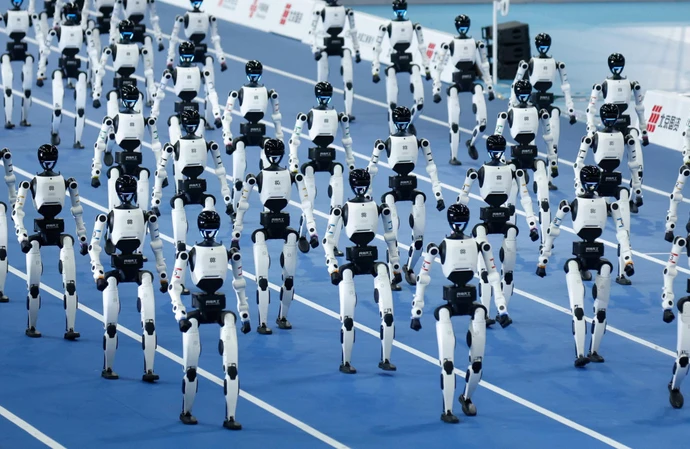
Chinese humanoid robots have beaten human world records at the opening of the World Humanoid Robot Games in Beijing, showcasing the country's rapid progress in advanced robotics.
More than 2,000 humanoid robots are taking part in the five-day event, which features 51 events and more than 1,000 competitions, including running, table tennis, football, weightlifting and tug of war.
At Saturday's (22.08.26) opening ceremony, a humanoid robot completed the 100-metre sprint in 9.39 seconds, beating Usain Bolt's human world record of 9.58 seconds set in 2009.
Another robot cleared 2.88 metres in the standing high jump, surpassing the human record of 2.45 metres set by Cuba's Javier Sotomayor in 1993.
Both robots were developed by Beijing-based X-Humanoid.
The sprint record was subsequently beaten during a trial by a humanoid robot from Chinese smartphone maker Honor, which completed the distance in 9.32 seconds at a reported top speed of 14.5 metres per second.
The games are being held at Beijing's National Speed Skating Oval, built for the 2022 Winter Olympics.
The event is in its second year and forms part of a wider push by China to demonstrate its capabilities in robotics.
The games coincide with the 2026 World Robot Conference in Beijing, where companies displayed around 3,000 robotics products, including humanoid machines.
China produces the majority of the world's humanoid robots, although its industry faces growing scrutiny from the US. Last month, the Federal Communications Commission announced restrictions on imports of new foreign-made humanoid robots, citing national security concerns.
The Pentagon has also added Chinese robotics company Unitree to a list of companies it says have links to China's military. Beijing has rejected such accusations.
Despite the record-breaking demonstrations, humanoid robots remain largely confined to research, entertainment and showcase events.
Experts say widespread commercial use will require further advances in reliability, autonomy and cost.
Spectators at the games said they were impressed by the technology.
Yang Shangzheng, a spectator, said: "These sports are perfectly normal for humans, but now robots can do them.
"I find it amazing."
The organiser said competitors from 16 countries, including Germany, Japan and the United States, are taking part in this year's games.